Before the reward system, two rooms full of sticky notes.
You can't reward behaviour you haven't mapped. Across two working sessions with the ConveGenius team, we did the unglamorous part first — who's on the app, what they come to do, and what already moves them. This is the discovery the gamification system was built on.
We sorted students by what moves them, not what grade they're in.
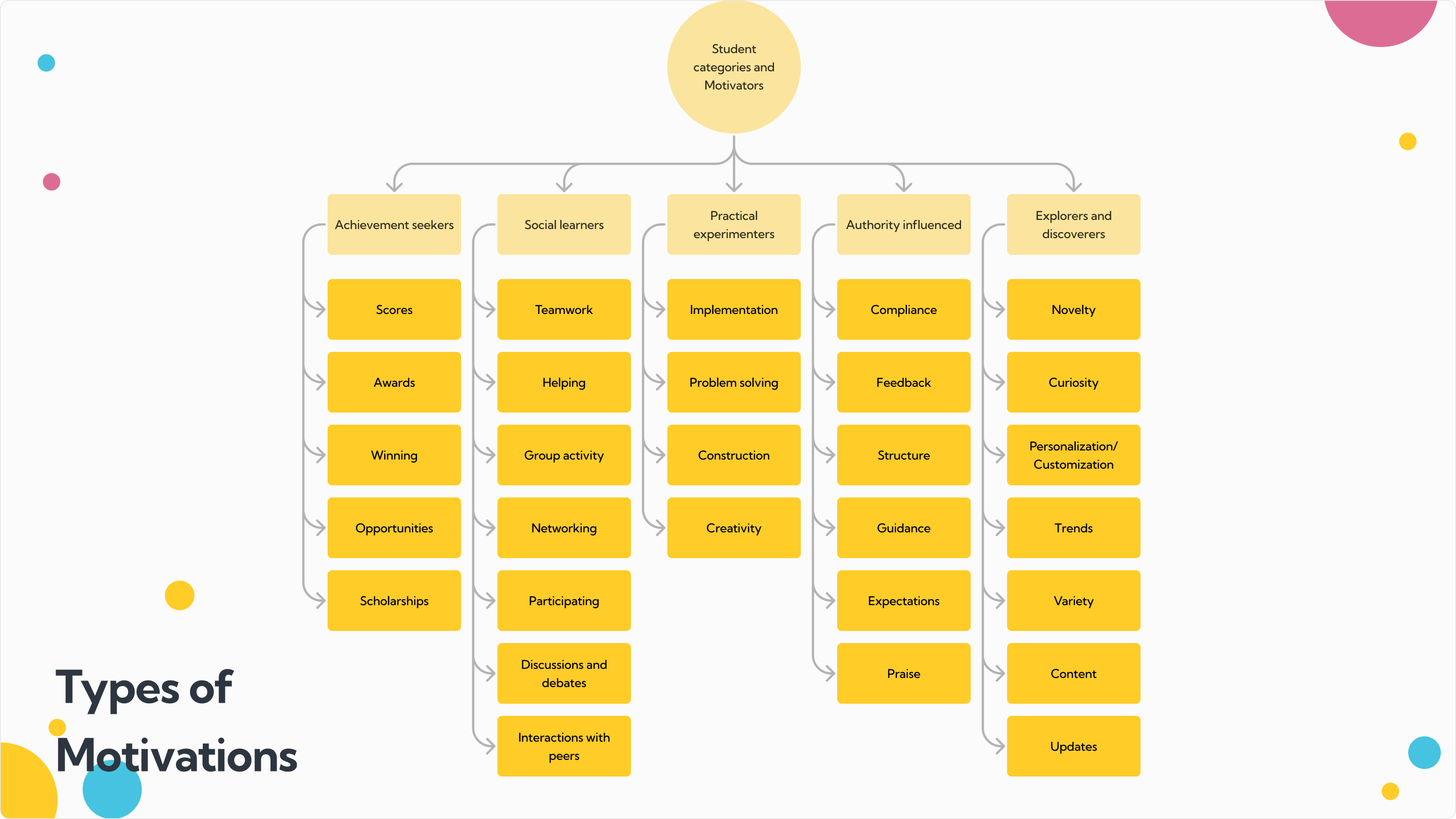
The team knows its users from the inside. We pulled that knowledge onto the wall as motivation types — the achievement-driven, the social, the ones who only show up when a teacher says so, the explorers poking at every feature:
Achievement seekersSocial learnersPractical experimentersEncouraged by the teacherCompetitors — quizzersGamers / engagersExplorers — featuresDiscoverers — contentUtility usersFocused on a target
Those collapsed into five motivation types we could design against — and a mind-map of the motivators behind each:
Doubt clearancedaily / on-demandAI doubt-solver bots — they come when stuck
Social competitionwants dailyolympiads, live quizzes, competition zone
Continuityongoinga forward bet — future product hooks
Broader impactseasonalvaries by the age of the student
Business / governanceon-demandplus Assessment, roughly yearly
The room's sharpest finding was a gap: they wanted Social Competition every day — but didn't have enough daily content to feed it. Discovery, via the Posts feed, became the daily lever instead.
the reward landscape
What already rewards students — and what could.
Before adding anything, we inventoried what the app already does, then opened up the field of what's possible. That gap is the design space.
Already in the system
Spin the wheel
Score cards for quizzes
Confetti on task completion
Lucky draw
Live-quiz leaderboard (top 1–10)
Certificates for competition-zone winners
Olympiad rank (AIR) notifications
Teacher rewards for best reel
Likes & comments
Universal leaderboard / learning score
On the table
Badges & points
Streaks
Collections — a Pokémon-card-style social ecosystem
Monetary — goodies, in-app economy
Scholarships & loans
Recognised certifications
Premium feature unlocking
Celebration animations & stickers
Teacher praise
Career counselling · fast-track for professionals
References we held in the room for what "good" feels like: Duolingo and Brilliant.